 By Samuel Jose
Walk into any social night or workshop in Singapore, and you’ll spot it instantly: a dancer showing off triple spins, whips, or syncopations while their partner struggles to follow.
The crowd may clap, but the real connoisseurs quietly notice what’s missing: connection.
In West Coast Swing, success isn’t measured by how many patterns you know, but by how musically, patiently, and responsively you dance within them. And that magic begins with timing and tension.
Timing: The Invisible Backbone of Great West Coast Swing
Timing isn’t just staying “on beat.” It’s living inside the beat.
In Singapore’s dance studios, most beginners focus on memorizing footwork — 1-and-2, 3-and-4, without truly hearing the texture of the music. West Coast Swing, however, is a partner conversation set to rhythm. You can’t just count it; you have to feel it.
When your timing is slightly ahead or behind your partner, the connection collapses. You start to lead by force instead of by rhythm. But when both partners share the same musical pulse, it feels effortless and almost telepathic.
Pro tip:
Learn from a good instructor who can train you to breathe with the rhythm, syncing movement with the rise and fall of musical energy. This is what separates a dancer who “moves” from one who grooves.
Tension: The Subtle Science of Connection
“Tension” in West Coast Swing isn’t about stiffness; it’s about elasticity.
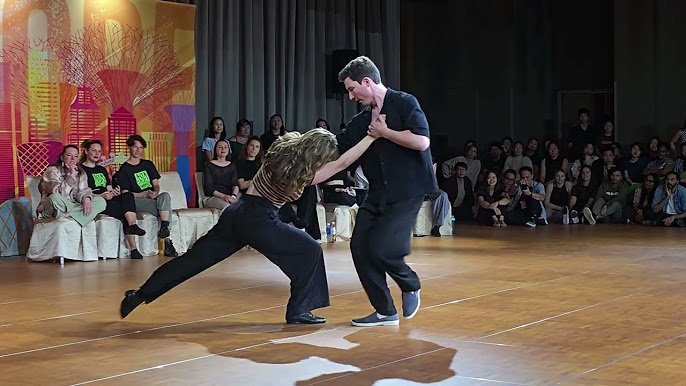
Imagine two magnets that attract, but don’t stick; that’s the perfect WCS tension. Too loose, and your lead disappears. Too tight, and your partner feels trapped. The right balance keeps the dance alive and conversational.
Singapore’s top dance studios often describe this as the “rubber band effect.” You stretch just enough to feel resistance, then release into the next beat. That stretch is where communication happens without words.
When your tension is calibrated correctly, every motion becomes clear, and you can whisper a lead instead of shouting it. You can express micro-emotions in milliseconds.
Connection Over Choreography
West Coast Swing has a quietly radical philosophy: it’s not about memorizing; it’s about responding.
Dancers who chase flashy moves without building connection often find their partners tensing up or hesitating. It’s like speaking fluent grammar with no listening skills.
But when timing and tension are in harmony, something beautiful happens: your partner trusts you. You move together as if you’re both improvising to the same breath. Even a simple sugar push becomes mesmerizing.
As one Singapore instructor put it,
“The real test isn’t whether your move looks cool. It’s whether your partner smiles after it.”
Why Fancy Moves Often Backfire
In Singapore’s competitive dance scene, especially among new West Coast Swing learners, there’s pressure to perform, to look sharp, to spin faster, to “wow” the crowd. But without timing and tension, fancy moves often:
- Break rhythm – You lose your musical phrase.
- Destroy connection – You start dancing with your partner instead of with them.
- Kill the groove – The smooth, jazzy essence of West Coast Swing disappears.
The irony? Audiences can feel good timing even if they don’t understand it. Smooth dancers are not flashy ones, but they are the ones everyone wants to partner with.
So, How to Train These Two Superpowers
If you’re learning West Coast Swing in Singapore, here’s how to level up beyond choreography:
1. Take a private dance class in Singapore
A private session allows your instructor to literally feel your connection and fine-tune your tension in real time. This tactile feedback is impossible in large group classes.
2. Dance slower
The slower the music, the more naked your timing becomes. Slow blues or acoustic swing forces you to control weight shifts and phrasing.
3. Watch social dancers, not competitors
Singapore’s West Coast Swing socials (like those at local studios or expat events) show you what real connection looks like: calm, rhythmic, and musical, not overproduced.
4. Record your dances
Video feedback is humbling but gold. Watch if your footwork aligns with the music and your partner’s momentum. Timing is visual as much as it’s felt.
5. Train micro-pauses
Good timing isn’t constant motion; it’s controlled delay. A half-beat pause, a playful drag, or an accented pause can make the dance feel alive.
Finally, The Paradox of Simplicity
Here’s the secret the best dancers know:
“ When you master timing and tension, simple moves feel extraordinary.”
It’s not about how much you do, it’s how deeply you inhabit the moment. A basic left side pass, done with precision, groove, and responsiveness, tells more story than a dozen rehearsed combos.
Singapore’s West Coast Swing community is still growing, but the dancers who rise fastest aren’t the flashiest; they’re the ones who listen better, sense earlier, and breathe together.
Because in the end, West Coast Swing isn’t just a dance. It’s a conversation in motion.