 By Samuel Jose
Speech and language development plays a fundamental role in a child’s ability to connect with the world. For children with autism spectrum disorder (ASD), communication challenges can vary widely, from difficulty with verbal language to trouble understanding social cues. Speech therapy, with its targeted techniques and compassionate approach, offers children with autism pathways to enhance their communication abilities. Today, speech therapy activities for autism are more dynamic and engaging than ever, offering hope to families and professionals alike.
Understanding the Role of Speech Therapy in Autism
Speech therapy addresses a wide range of communication issues that individuals with autism may face. These include verbal and nonverbal communication, understanding and using gestures, improving social skills, and fostering receptive and expressive language abilities. Some children with autism may be nonverbal and require alternative communication systems like picture boards or speech-generating devices, while others may have strong vocabularies but struggle with conversational nuances or pragmatic language.
A customized approach is essential. No two children with autism are identical, and neither are their communication needs. Speech therapists tailor activities and interventions to suit each child’s abilities, interests, and challenges. Through playful yet structured exercises, children can build confidence in expressing themselves, participating in conversations, and interpreting the world around them.
Principles Behind Effective Speech Therapy Activities for Autism
Effective speech therapy for autism goes beyond repetitive drills. It centers on creating meaningful, motivating contexts for communication. Activities must be engaging, rewarding, and adaptable to a child’s evolving needs. A few key principles drive successful speech therapy activities for autism:
-
- Play-Based Learning: Many children on the autism spectrum learn best through play, which provides a natural, low-pressure environment for language use and practice.
- Visual Supports: Visual aids such as picture cards, schedules, and visual prompts can significantly reinforce understanding and recall.
- Consistency and Repetition: Frequent practice in varied settings solidifies new skills and builds confidence.
- Functional Communication: Focus on communication that serves real-world needs, such as requesting, refusing, commenting, and asking for help.
- Individualized Targets: Activities should be directly aligned with each child’s specific speech and language goals.
With these guiding principles in mind, speech therapy activities for autism can foster meaningful progress while maintaining an atmosphere of fun and discovery.
Speech Therapy Activities for Autism That Foster Growth
While the specific activities a therapist chooses will depend on a child’s goals and abilities, several time-tested techniques continue to show promise across a broad range of needs.
Interactive Reading Sessions
Books offer a natural platform for language development. Interactive reading sessions go beyond merely reading aloud; they involve pausing to ask questions, pointing to pictures, discussing what characters are doing, and encouraging the child to predict what will happen next. Therapists may use books with repetitive phrases to help children learn language patterns or select wordless picture books to stimulate storytelling and description skills.
Moreover, reading together provides opportunities to introduce new vocabulary, explore emotions, and practice turn-taking. Engaging a child through stories they find interesting increases motivation to participate and communicate.
Use of Visual Schedules and Picture Exchange Systems
Visual schedules break down daily routines or activities into manageable steps, often using pictures instead of words. These schedules support comprehension, reduce anxiety, and promote independence. For children developing speech, a Picture Exchange Communication System (PECS) can be introduced. PECS encourages children to initiate communication by handing over a picture to request a desired item or activity.
Implementing visual systems supports expressive communication for children who may not yet be verbal and strengthens understanding of sequencing and time concepts.
Imitation and Modeling Games
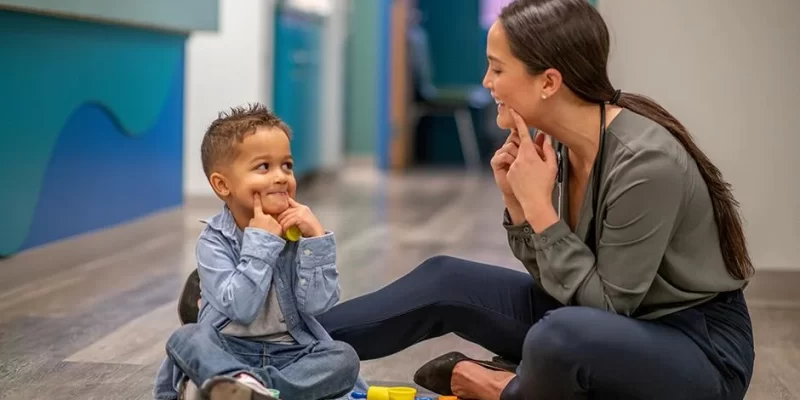
Imitation is a fundamental communication skill. Therapists often model sounds, words, gestures, or actions and encourage the child to imitate them. Activities like “copy me” games, singing songs with hand motions, or acting out scenes with toys can build imitation skills in a playful context.
Modeling appropriate language during everyday activities also exposes children to natural examples of communication. For instance, while playing with blocks, a therapist might comment, “Look, a big tower!” and encourage the child to repeat or respond.
Play-Based Language Expansion
Therapists use a child’s natural play interests as a springboard for language growth. During pretend play with dolls, cars, or a toy kitchen, the therapist introduces descriptive words, action words, and social language. If a child says “car,” the therapist might expand it to “The car is fast!” This technique, known as language expansion, encourages more complex speech without pressuring the child.
The key is to follow the child’s lead, ensuring that communication remains enjoyable and intrinsically rewarding.
Turn-Taking and Conversational Practice
Many children with autism benefit from structured practice in the back-and-forth rhythm of conversation. Simple turn-taking games, such as rolling a ball back and forth or playing board games, lay the groundwork for conversational exchange. As skills develop, therapists guide children in greeting others, asking and answering questions, and making comments relevant to a topic.
Role-playing scenarios—such as ordering at a restaurant, asking for help, or greeting a new friend—offer practical applications for these conversational skills.
Sensory Integration Activities
For children with sensory processing challenges, integrating sensory activities into speech therapy can enhance engagement and communication. Activities like playing with textured materials, water play, or swinging can create opportunities for spontaneous language use.
Therapists might encourage children to request preferred sensory experiences, describe textures, or express feelings related to sensory input. Sensory-rich environments, when used thoughtfully, can lower anxiety and open the door for communication breakthroughs.
Social Stories and Role-Playing
Social stories are short narratives that describe a social situation and the expected behaviors in a clear, simple way. These stories help children understand what to expect and how to respond in various social contexts. Therapists may pair social stories with role-playing exercises to reinforce the skills.
Role-playing allows children to practice greetings, sharing, problem-solving, and other social interactions in a supportive environment, helping them generalize these skills to real-life situations.
Technology-Assisted Communication
For some children, augmentative and alternative communication (AAC) devices such as tablets with specialized apps provide essential tools for expression. Speech-generating devices enable nonverbal children to communicate effectively, promoting autonomy and reducing frustration.
Therapists incorporate these tools into sessions, teaching children how to navigate the devices to express needs, make choices, and participate in conversations.
The Importance of Collaboration and Family Involvement
Speech therapy activities for autism do not happen in isolation. Collaboration between therapists, families, teachers, and caregivers is vital to success. When families understand and reinforce strategies at home, progress accelerates. Therapists often provide training and resources for parents to continue therapy activities within daily routines, such as during mealtime, bath time, or playtime.
Moreover, involving other professionals—such as occupational therapists, behavioral therapists, and educators—ensures a holistic, coordinated approach to a child’s development.
Family-centered therapy acknowledges that caregivers know their children best. By partnering with families, speech therapists create sustainable communication systems that reflect each child’s environment and experiences.
Measuring Progress in Speech Therapy for Autism
Progress in speech therapy may not always follow a linear path. Some children show rapid gains in certain areas, while others may progress more gradually. Measuring success involves tracking not just vocabulary growth or speech clarity, but also improvements in social interaction, emotional regulation, and functional communication.
It’s important to celebrate small victories—such as a child pointing to request a snack, initiating eye contact, or stringing two words together. Each milestone represents a significant step toward greater independence and connection.
Therapists continually assess and adjust goals to match the child’s evolving needs. This flexible, responsive approach maximizes opportunities for communication breakthroughs, ensuring that therapy remains relevant and empowering.
Looking Ahead: A Lifelong Journey
Speech therapy activities for autism support more than language development; they nurture a child’s sense of agency and belonging. Through patience, creativity, and evidence-based practices, speech therapy opens doors for children with autism to express themselves, connect with others, and navigate their worlds with greater ease.
While early intervention is ideal, communication development is a lifelong journey. Continued support into adolescence and adulthood ensures that individuals with autism can meet new challenges, whether that means preparing for employment, building friendships, or advocating for their needs.
As understanding of autism continues to grow, so too does the field of speech therapy. New research, innovative technologies, and an unwavering commitment to individualized care promise a future where every child’s voice is heard, respected, and celebrated.